


Explore Looe
Explore Looe and discover more about its rich history and interesting heritage. Looe was at one time two separate borough towns – West Looe and East Looe. Each had its own mayor and corporation and sent two members to parliament. It was an important port exporting tin, copper and granite; a safe haven for fishing boats and an important boat building centre, as well as being home to some interesting characters.
Scroll down to find out more about the points of interest on the Looe Heritage Trail Map.

Point 1 – Millpool
The area around Millpool grew up around the tidal mill on the river during the 17th century. Over time, the pool was infilled and redeveloped, becoming the town’s main car park in the 20th century although remnants of the original basin persist as a small boating lake.
Millpool is now the home of the Looe Library and Community Hub which houses the tourist information centre and Town Council offices.
Point 2 – The Old Mill
Situated at the point where the East and West Looe Rivers converge, a mill was first built on this site in the 17th century and continued operating until the early 20th century. Although it was a grain mill for many years, it was also later used to grind bones for fertilizer.
In 1614, Thomas Arundell (who went on to be the MP for West Looe) was granted the parcel of land that is now mostly the Millpool Car Park. He built a stone wall around the pool with a grain mill and houses. Lock gates were constructed at the seaward end and the flow of the incoming tide would open the lock gates and the pool would fill up. When the tide turned, the gates would be closed by the force of the water and the contents of the pool used to work the four undershot water wheels in the mill house. As you cross the bridge (point 3) look back and low down for the bricked up archways where the used water came out.
Point 3 – Looe Bridge
The bridge you see today was originally built in 1853 to replace the former medieval one (point 4) and then widened in 1960. It has seven arches spanning the river and the tunnel arch at the western end was for vehicles to access to West Looe, before Quay Road and the ramp was constructed in the 1890s. At the bottom of the ramp, a stone laid by Prince George Duke of Kent in 1931 marked the start of the refurbishment of the quay side.
The bridge was widened on the upstream side, and you can see the joins underneath the arches and a slate plaque halfway across the bridge commemorating the work. A further arch, on the east side, has been filled in but arch stones can be seen on the seaward side.
Point 4 – site of Medieval Looe Bridge
On the wall along Quay Road by the Old Bridge House is a stone which reads “repeared by the county in 1689”. This is the location of the medieval Looe bridge which was completed in 1436 and then replaced by the Victorian one in 1853.
The medieval bridge replaced an even earlier wooden bridge. It was built of stone and had 15 uneven stone arches. William of Worcester wrote in 1478 describing the bridge as ‘six bow shots’ in length. It had a central buttress with an oratory dedicated to St Ann
Point 5 – St Nicholas Church
The people of West Looe had to go to Talland to attend church until the 14th century when St Nicholas Church was established by the Dawnay family. In the 16th century, it became the Guildhall and even the jail, before it was restored as a church in 1852. The ‘dark house’ of the jail is still visible on the north wall although the door to it is now blocked up.
It was the efforts of the Rev. E. Seymour who restored the church in the mid-19th century. Oak pews with carved and decorated ends, the priest’s stall, and the font cover are all splendid examples of mid-20th century ecclesiastical furniture by Rev. John Harvey. Can you spot the curious feature in the Good Samaritan stained glass window on the east wall of the north aisle? The tower clock is an exact replica of the 18th century original but now has an electronic mechanism so the time can be adjusted remotely.
Point 6 – The Jolly Sailor Inn
The Jolly Sailor (known locally as simply ‘The Jolly’) is Looe’s oldest pub, built in the 15th century. The pub originally sat on the banks of the river with ships mooring alongside but land reclamation and new buildings in the 19th century means it’s now on West Looe Hill.
The pub features in many Looe legends involving smugglers, press gangers and avoiding the customs men and its décor includes timbers from old ships including HMS Indefatigable. It was originally two buildings. The house to the left was originally a bakers before being incorporated into the pub as landlord’s accommodation in the 1930s and then B&B rooms more recently.
Point 7- The Old Meat Market
The meat market building was constructed in 1853 in an unusual hexagonal shape with louvred windows that allowed in as much fresh air as possible. This kept the meat fresh in the days before refrigeration.
Live animal auctions would have been held just outside, which were announced by the ringing of a bell in the cupola. The weathervane at the top depicts an archer mariner armed with a sword, bow and arrow; a symbol which is also on taken from the ancient West Looe Town seal.
Point 8 – Darloe House (The Captain’s House)
This Grade II listed Georgian house was originally built for Captain Parkins Prynne, a local naval officer who fought in the Battle of Trafalgar in 1805. He and his wife Lucy had 12 children so it would have been a busy household.
The house was first built in the late 18th century and was listed in 1973 due to its historic interest. Now a private home so not open to the public, the interiors have many original features including a stunning central staircase. Captain Prynne died in 1838 and is buried at Talland.
Point 9 – West Looe Hill
West Looe Hill is a steep, narrow lane rising from the harbour area of West Looe. Now in the conservation area, it forms part of what was the “historic road to Polperro” and is flanked by old cottages and houses.
Beyond its domestic architecture, West Looe Hill also shows the layers of settlement and transport evolution: as town sprawl climbed the slopes above the quay, new lanes like West Looe Hill served as the link between harbour and upland fields.
Point 10 – Sardine Factory & Looe Heritage Centre
The former sardine factory was restored and converted in 2017 to create a brand new restaurant, heritage centre and café. The original building was constructed in the 19th century as a sardine factory which itself was built on the site of an old copper ore yard. It originally had a flat roof for drying the sardines with a pitched roof added later.
Archaeological excavations done at the time of the conversion found evidence of salting pits and a brick lined flue that may have been part of the smoking process. New doors and windows were inserted into the walls during the twentieth century. The building’s most recent claim to fame is that is was used as a filming location in ‘Beyond Paradise’ where it became the ‘Ten Mile Kitchen’.
Point 11 – Pennyland
Pennyland as you see it today is largely the work of 19th century architect and engineer Joseph Thomas who created the Hannafore estate and constructed the road that now runs along Pennyland to Hannafore.
You will actually get a better view of the arches and turrets here when you reach the other side of the river later in the trail. Although the turrets were purely decorative, they did serve as gun emplacements during Second World War.
Point 12 – The Downs
West Looe Downs has been owned and managed by West Looe Town Trust since 1874 as amenity land for the benefit of the local community. There is free access to the grassed and wooded areas and it was formally designated common land in 2024.
Point 13 – Shutta
Shutta was the earliest part of Looe to be settled with records suggesting it was inhabited as early as the 12th century. In medieval times, Shutta (the name comes from the ‘shute’ of fresh water running down the valley) may have been the original core of settlement on that side of the estuary, clustering around a tidal inlet and quay and linked to the transport routes at the time.
Over time, Shutta became more residential as port and fishing activity moved further down the river. In the 19th and 20th centuries, modern housing developments gradually enclosed the valley and hillside, reshaping Shutta into the quiet suburban road it is today, while still retaining the distinctive steep lanes and older building fabric that hint at its early settlement character.
Point 14 – Buller Quay
Buller Quay was built in 1856 to support the local copper and granite industry, and takes its name from the Buller family, who for almost two hundred years were MPs for Looe. An exceptional lode of copper was discovered on Bodmin Moor in 1836, so a quay was needed to store the copper that had come down from the moor by canal and railway to be shipped out to smelting works in South Wales. The railway originally ran along Buller Quay and there is still a section of track embedded in the quay.
The success of the copper and granite industry brought prosperity to Looe and helped to fund the building of the new bridge. To this day, the ground underneath the quay still contains a lot of copper, and trees planted along the wall sometimes die from its effects.
Point 15 – Guildhall and Town Clock
The Guildhall was built in 1877 in a Gothic Revival style to replace the smaller medieval building in Higher Market Street. It has a series of stained glass windows illustrating Looe’s history. The building is owned by East Looe Town Trust and in recent years has also become known as the Shipton Abbott police station in ‘Beyond Paradise’.
East Looe and West Looe didn’t combine into one borough until 1898 which is why it’s just the coat of arms of East Looe over the door. The single masted ship with two figures is said to represent Joseph of Arimathea and is nephew the boy Jesus who legend says stayed on Looe Island whilst his uncle traded in Looe for tin on Bodmin Moor.
Point 16 – Barbican Hill
Barbican Hill rises steeply above the eastern side of East Looe, commanding sweeping views over the river and bay. The name “Barbican” suggests a fortified position or outer defensive work, and indeed the hill is believed to have once had a fortification marking the upper limit of the medieval town’s extent. The listed house known as The Old Barbican is a late 18th-century remodel of an older dwelling, and its listing cites its location as “an old fortified site”.
Barbican Hill contains some of the key 20th-century expansions of East Looe away from the cramped town centre and up onto more open land. Its roads climb from the older village below and lead out towards the open countryside and coast-path above, linking with areas such as the open fields of The Wooldown.
Point 17- The Golden Guinea
The Golden Guinea is one of Looe’s finest old houses and the date of 1632 may be found in the middle corbel of the left hand upstairs window. Thomas Bond lived here; he was a 19th century author, topographer and Town Clerk to both East and West Looe councils. He left 10,000 guineas in gold to his heirs.
The building has been a restaurant for many years now, but it still has some interesting original features inside.
Point 18 – Dowling & Brays (now Jack Bray & Sons)
The timbered exterior of this building dates back to 1666 and was originally built as a merchant’s house, handy for the nearby quay and market areas. Over the years, it has remained a prominent Fore Street commercial premises, being occupied by businesses including an antiques shop and clothing retailer.
Point 19 – The Old Salutation Inn
The Old Salutation Inn is a Grade II listed building, with the front range dating from the 17th century which was later remodelled in the 18th century. Records show that the Salutation was already an inn by 1791 and has continued to welcome visitors since.
The original Shark Angling Club used to meet in the Inn and it was, for a time in the eighteenth century a Temperance Hotel. It has distinctive sloping floors which were useful when high spring tides flooded the building.
Point 20 – Ye Olde Cottage (1456)
Considered the oldest surviving building in Looe (apart from the churches), although the date of 1456 may be 100 years too early, the house was probably constructed for a merchant or trader in the port.
Point 21 – Smugglers Cottage
Another very old Looe building is Smugglers Cottage, now a restaurant but also likely constructed as a merchant’s house. It has a truly massive chimney and timbers from the Spanish Armada are said to have been used in the remodelling and extension of the house.
It gets its current name from the belief that it once had a secret passageway in the cellar that was used for hiding smuggled goods.
Point 22 – Old Guildhall and Museum
The Old Guildhall was built in 1450 and after it was raised to accommodate a first floor in 1587, was used as the Magistrates Court and Town Hall until 1878, when the new Guildhall was ready. Beneath the magnificent timber roof, laws were made and enforced and the town was administered by the Mayor and Corporation.
Retained medieval features in the building include the prison cells downstairs and the raised Magistrates’ bench with the Royal Coat of Arms and it is now the home of Looe Museum with many interesting artifacts.
Point 23 – The Fishermen’s Arms
The Fishermen’s Arms on Higher Market Street in East Looe occupies a timber-framed building dating to the early 17th century, with a date of 1611 recorded in plasterwork on the upper floor. Originally constructed as a merchant’s house, it was later adapted into a public house, serving local fishermen and seafarers. The building is listed Grade II* for its special architectural and historic interest.
In 1883, the landlord William Elford had his licence endorsed for opening on a Sunday and then in 1885, he was fined £5 for allowing drunkenness. The building is even rumoured to be haunted by the ghost of someone who died in the loft in 1875.
Point 24- St Mary’s Church
The original building on this site was built in 1259 as a chapel of ease connected to St Martin’s By Looe church. The tower dates to this time but the church building itself was rebuilt in the late 19th century. Note the single clock face that points towards East Looe so those in West Looe can’t see it!
The tower used to be whitewashed and used as day marker for shipping up until the beginning of WW1. The church was converted to residential use in the 1990s.
Point 25 – The Old Lifeboat Station
The Old Lifeboat Station was established in 1866, next to the Watchtower, and remained in use until 1930 when the lifeboat service was withdrawn and not reinstated until 1992.
The Old Lifeboat Station is owned by East Looe Town Trust, and an extensive renovation was completed in 2025. It is now the home of a distillery with East Looe Town Trust’s offices in the Watchtower.
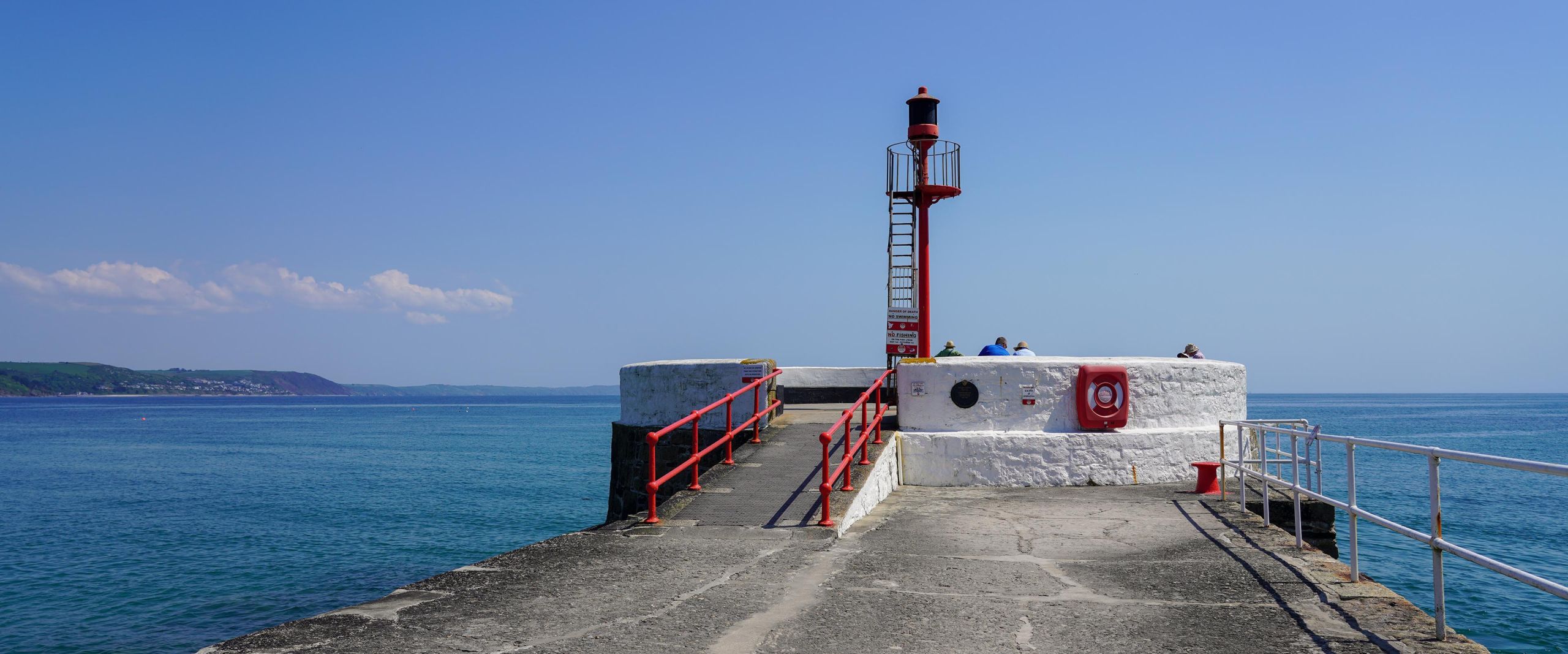
Point 26 – Banjo Pier
The Banjo Pier was finished in 1897 and was designed by Joseph Thomas as a way to prevent the harbour mouth silting up. Admiral Riley who was Chairman of the Harbour Commissioners, gifted the lamp which is at the pier end.
The pier was to be named ‘Riley’s Pier’ but its nickname, coined because a local remarked it looked like a banjo, is the name that has stuck.
Point 27 – Warehouses
The handsome row of quayside warehouses in East Looe dates largely from the mid-19th century, when the town’s status as a working port was at its height. Following the 1848 Harbour and Bridge Act, the newly-formed Harbour Commissioners oversaw major improvements: the river bed was cleared, a new quay built and by 1870 a sequence of large stone warehouses had been erected along what is now Buller Quay
The construction was driven by the booming mining and export trade: copper ore and granite from Bodmin Moor’s mines and quarries were brought down by canal and railway, then shipped out from Looe.
Point 28 – The Wooldown
The Wooldown was historically farmland where animals grazed well into the 1960s. In the ownership of East Looe Town Trust since 1949, it was purchased for public use and the Trust agreed to never erect buildings on it. The hexagonal seated area in the middle is built on the site of a WW2 lookout station and a windmill used to stand in the very top field.
The Wooldown is now an area of significant biodiversity, retaining its original field-hedge structure and hosting species-rich wild flower meadows, hedgerows and scrub that provide habitat for birds, butterflies and small mammals. It is a peaceful place to enjoy Looe’s beautiful coastal views.